
Uncategorized

Chatbot or Human? Where AI Customer Service Is Costing Businesses Sales

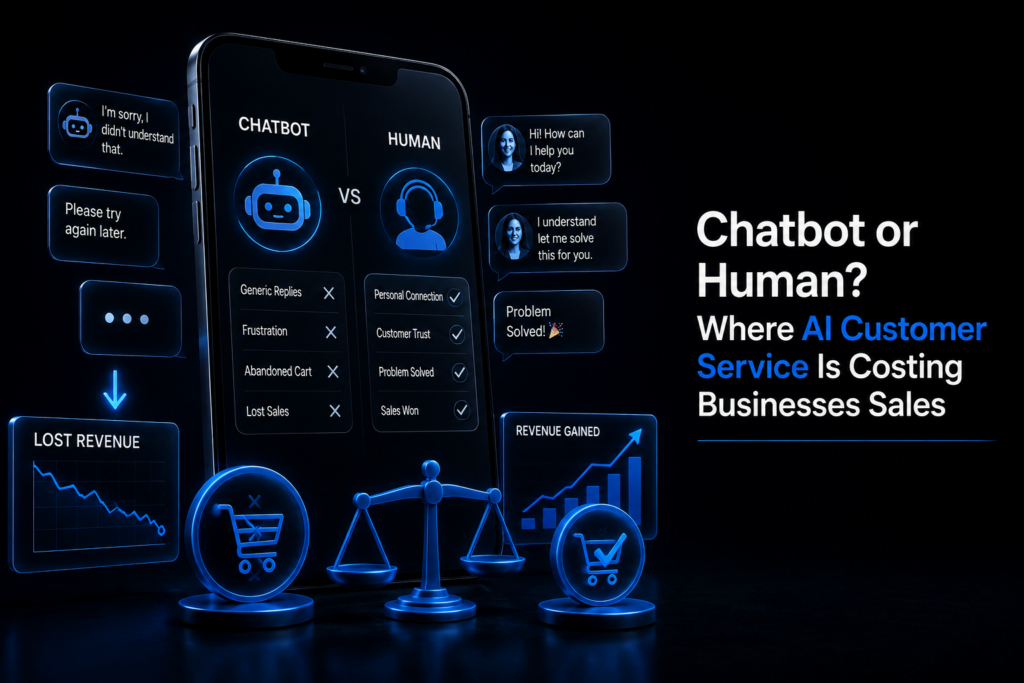
Customer service has changed dramatically in recent years. Businesses now use artificial intelligence to answer questions, recommend products, resolve common problems, and provide support around the clock. For many companies, AI customer service appears to offer an attractive combination of speed, efficiency, and lower operating costs. However, convenience does not always translate into better customer experiences or higher sales. When businesses rely too heavily on automated conversations, they can unintentionally create frustration at critical moments in the buying journey. Customers may struggle to explain complex problems, receive irrelevant answers, or become trapped in repetitive chatbot conversations. Consequently, businesses can lose valuable sales while believing they are improving efficiency. A smart digital marketer understands that technology should support customer relationships rather than replace human understanding completely. The AI Revolution That Came With a Hidden Price AI-powered customer service has become increasingly attractive because businesses can respond to customers at any time. A chatbot can handle frequently asked questions, provide basic information, and direct customers toward relevant resources without requiring a human employee to respond to every message. Therefore, businesses can reduce pressure on customer service teams while maintaining continuous availability. However, the real cost appears when automation replaces human interaction in situations that require empathy, judgment, or detailed understanding. A customer who needs help choosing an expensive product may not want a list of automated answers. Instead, they may want someone to understand their specific requirements and provide personalized guidance. If the business fails to provide that experience, the customer may simply leave and purchase from a competitor. When a Helpful Chatbot Becomes a Frustrating Barrier A chatbot should make communication easier, not create another obstacle. Unfortunately, many automated systems force customers to select from rigid options before they can explain what they actually need. When the customer’s question does not match the available choices, the conversation can quickly become frustrating. Moreover, customers often repeat themselves when a chatbot fails to understand their intent. They may type the same question in different ways, only to receive similar automated responses. Consequently, the customer begins to feel that the business is not listening. For a digital marketer, this represents more than a customer service issue because frustration at this stage can directly affect brand perception and conversion rates. The Sales Opportunity AI Cannot Always Recognize Human customer service representatives can recognize buying signals that automated systems may overlook. For example, a customer might ask several questions about product quality, delivery time, warranty coverage, or payment options. These questions may indicate strong purchase intent, even if the customer never directly says, “I want to buy this.” A skilled representative can respond by understanding the context and guiding the customer toward a decision. In contrast, an automated chatbot may answer each question separately without recognizing the larger opportunity. Therefore, businesses that rely exclusively on automation can sometimes lose customers who were already close to making a purchase. Customers Want Answers, But They Also Want Understanding Speed matters in customer service, but speed alone does not create satisfaction. Customers want accurate answers, yet they also want to feel understood. This becomes particularly important when they experience a problem, have concerns about a purchase, or need help with a complicated decision. Human representatives can respond to emotions and adapt their communication accordingly. If a customer feels disappointed, a human can acknowledge the frustration and adjust the conversation. Although AI can imitate empathetic language, it may not always understand the deeper context of an emotional situation. As a result, businesses should carefully decide which interactions require automation and which require human involvement. The Biggest Mistake: Treating Every Customer the Same Not every customer enters a conversation with the same goal. One person may want a simple product specification, while another may need detailed assistance before spending a significant amount of money. Nevertheless, businesses sometimes use the same chatbot experience for everyone. Effective customer service should consider customer intent, purchase history, behavior, and the complexity of the request. For example, a chatbot can efficiently answer questions about opening hours, shipping policies, or basic product specifications. However, customers who demonstrate strong purchase intent or present complicated concerns may benefit from immediate human assistance. This combination creates a more flexible experience. Automation Should Support Humans, Not Replace Them The most effective approach is not necessarily choosing between a chatbot and a human representative. Instead, businesses can combine both. AI can manage repetitive questions while human employees handle conversations that require deeper reasoning, negotiation, empathy, or personalization. For instance, a chatbot can begin a conversation by identifying the customer’s basic requirement. If the customer asks a complex question or indicates dissatisfaction, the system can transfer the conversation to a human representative. Consequently, employees spend less time answering repetitive questions while customers still receive human assistance when it matters most. A digital marketer can play an important role in designing this approach because customer service forms part of the broader customer journey. Marketing attracts the customer, while customer service can influence whether that customer completes the purchase and returns in the future. The Cost of Saving Money in the Wrong Place Businesses often adopt AI customer service because they expect it to reduce costs. Automation can indeed reduce the workload associated with repetitive tasks. However, businesses should not measure success only by how many human interactions they eliminate. If automation reduces customer service costs but also lowers conversion rates, increases complaints, or causes customers to abandon purchases, the business may actually lose money. Therefore, companies should evaluate AI customer service according to business outcomes rather than automation volume. Metrics such as customer satisfaction, conversion rate, retention, resolution rate, and revenue per customer provide a more complete picture. The Danger of Making Customers Fight for a Human One of the most damaging chatbot experiences occurs when customers cannot reach a human representative. Businesses sometimes design automated systems specifically to prevent human escalation because they want to minimize support costs. However, this approach can create resentment. Customers should not have to repeatedly type phrases
Uncategorized

Why Your Retargeting Ads Keep Annoying Customers Instead of Converting Them

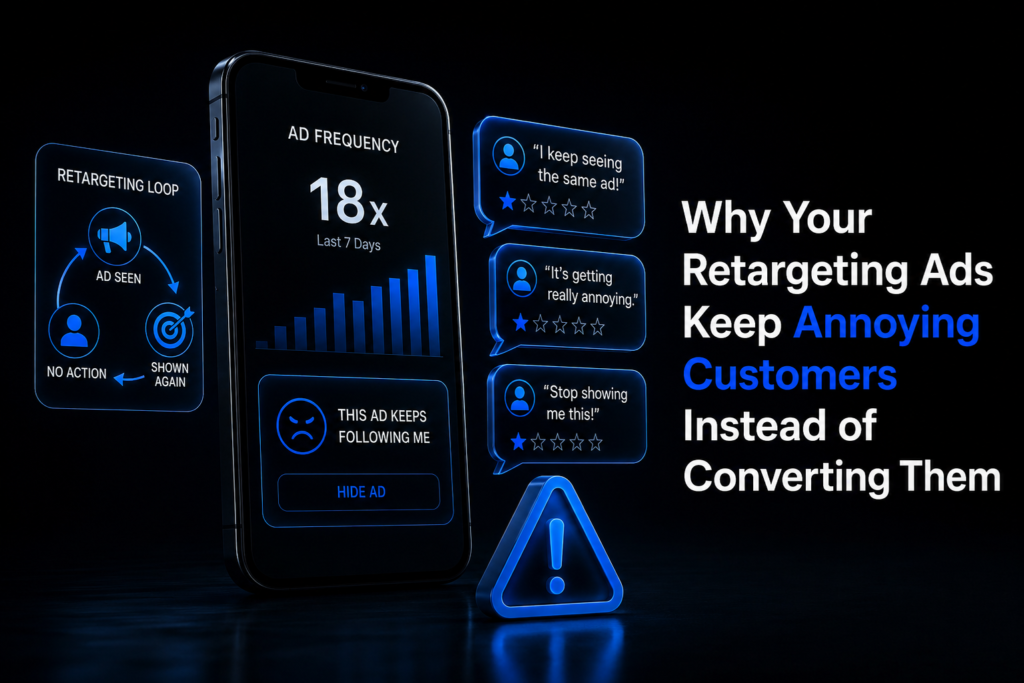
Retargeting ads have become an essential part of modern digital marketing. They allow businesses to reconnect with people who have already visited their website, viewed a product, interacted with content, or shown interest in a service. In theory, this strategy should help businesses convert warm audiences more efficiently than completely new prospects. However, when marketers use retargeting without a clear strategy, these ads can quickly become repetitive, intrusive, and frustrating. Instead of encouraging customers to return, poorly managed retargeting ads can create the impression that a brand is following users everywhere. Consequently, customers may ignore the advertisements, develop negative feelings toward the brand, or actively avoid the product. The good news is that marketers can solve many of these problems by improving audience segmentation, ad frequency, messaging, timing, and creative strategy. When Retargeting Becomes Too Much of a Good Thing Retargeting works because it reminds potential customers about something they previously considered. However, constant reminders can quickly become excessive. A user who viewed a product once may suddenly see the same advertisement across social media, websites, and mobile applications for several days. Instead of creating interest, the repeated exposure can make the customer feel uncomfortable. Furthermore, repetition can reduce the effectiveness of your advertising campaign. When people see the same creative repeatedly, they may stop noticing it altogether. Therefore, marketers must find the right balance between staying visible and respecting the customer’s attention. Effective retargeting should feel relevant rather than relentless. The Real Reason Customers Start Ignoring Your Ads One of the biggest problems with retargeting is a lack of relevance. Many businesses place everyone who visits their website into the same retargeting audience. However, visitors have different intentions. Someone who spent ten seconds on a homepage should not necessarily receive the same advertisement as someone who added a product to their shopping cart. For example, a customer who already purchased a product should not continue seeing an advertisement asking them to buy the exact same product. Similarly, someone who only read a blog post may not yet have enough purchase intent to receive aggressive sales messages. Consequently, audience segmentation plays a critical role in creating effective retargeting campaigns. Frequency: The Fine Line Between Reminder and Irritation Ad frequency refers to how often the same person sees your advertisement. While repeated exposure can increase brand recognition, excessive exposure can produce the opposite effect. Customers may become tired of seeing the same message, especially when the advertisement offers nothing new. Therefore, marketers should establish sensible frequency caps whenever the advertising platform allows them. The ideal frequency depends on the product, buying cycle, audience, and campaign objective. A customer considering an expensive service may need several reminders, whereas someone purchasing an inexpensive product may require far fewer. The goal should always remain clear: remind, do not overwhelm. Stop Showing Ads to People Who Already Converted One of the most frustrating retargeting experiences occurs when customers continue seeing an advertisement after completing the desired action. Imagine purchasing a pair of shoes and then seeing advertisements for those same shoes for another week. Instead of feeling valued, the customer may conclude that the company does not understand its own audience. Fortunately, marketers can prevent this problem by creating exclusion audiences. Once someone purchases a product, submits a form, books a service, or completes another conversion action, the marketer can remove that person from the original retargeting campaign. Instead, the business can introduce a different message, such as a complementary product, loyalty offer, review request, or referral opportunity. Your Creative May Be the Problem, Not Your Audience Even a well-segmented audience can become annoyed when marketers repeatedly use identical creative. The same image, headline, offer, and call to action can quickly lose its impact. Moreover, repetitive creative makes the advertising campaign look automated rather than personalized. For this reason, businesses should develop multiple ad creatives for each retargeting audience. Change the visual style, headline, value proposition, and call to action while maintaining a consistent brand identity. Consequently, customers can receive a fresh reason to reconsider the offer instead of seeing the same advertisement repeatedly. Give Customers a Reason to Come Back Simply telling customers, “You forgot something,” may not provide enough motivation to return. Effective retargeting should answer an important question: Why should the customer take action now? Therefore, marketers should build different messages around different stages of the customer journey. A visitor who viewed a product might receive an advertisement highlighting its benefits. Someone who abandoned a cart might receive a reminder about the unfinished purchase. A returning customer might receive a loyalty incentive or information about a complementary product. By matching the message to the user’s behavior, marketers can make retargeting more useful and persuasive. Timing Matters More Than Most Marketers Realize The timing of a retargeting advertisement can significantly affect its performance. A customer who visited a website five minutes ago may still remember the product clearly. However, someone who visited three months ago may have completely different needs or priorities. Consequently, marketers should create retargeting windows based on customer intent and purchasing behavior. High-intent actions, such as adding an item to a cart, may justify shorter retargeting windows. On the other hand, low-intent actions, such as reading an informational article, may require a longer period and softer messaging. The right timing makes the advertisement feel helpful instead of intrusive. Personalization Without Crossing the Line Personalization can make retargeting more relevant, but marketers must use it carefully. Customers appreciate advertisements that match their interests; however, overly specific messaging can sometimes make people uncomfortable. A brand should never create the impression that it knows more about a person’s private behavior than necessary. Instead, use behavioral information to improve relevance without becoming overly personal. For example, showing related products based on previous website activity can provide value. Similarly, creating different messages for new visitors, returning visitors, and existing customers can improve campaign performance. Thus, effective personalization should feel natural rather than invasive. Retargeting Should Follow the Customer Journey A strong digital marketing strategy

Uncategorized

The Hidden Cost of Ignoring Mobile Page Speed (And How to Fix It in a Day)

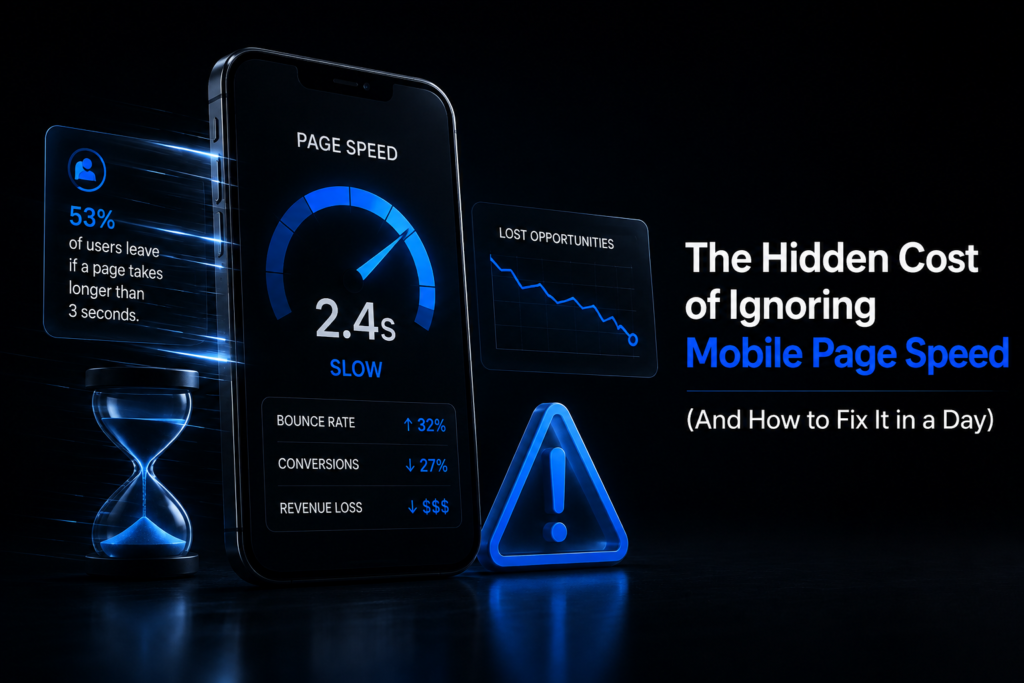
In today’s digital-first environment, users expect websites to load quickly, respond instantly, and provide a smooth browsing experience on every device. However, many businesses continue to focus primarily on desktop performance while overlooking the growing importance of mobile users. This mistake can quietly reduce traffic, engagement, leads, and sales. As a result, mobile page speed has become more than a technical concern; it has become a critical business and digital marketing factor. A slow mobile website can damage a brand long before a business realizes what is happening. Visitors may leave before seeing the main content, search engines may evaluate the user experience negatively, and potential customers may choose a competitor instead. Fortunately, businesses do not always need a complete website redesign to improve performance. With the right approach, you can identify major speed problems and implement meaningful improvements within a single day. The Silent Business Problem Behind a Slow Website A slow website rarely announces itself as a problem. Instead, it creates a series of small losses. A visitor waits for a page to load, becomes impatient, and leaves. Another user struggles with an unresponsive button and abandons a purchase. Meanwhile, a potential lead decides that a competitor offers a better experience. Individually, these incidents may appear insignificant, but collectively, they can create a substantial financial cost. Moreover, slow loading can affect every stage of the customer journey. From the first search result to the final checkout page, users expect speed and convenience. Therefore, businesses that ignore mobile performance risk losing opportunities even when their products, services, and content are excellent. Why Mobile Users Cannot Afford to Wait Mobile users often browse websites while commuting, shopping, researching products, or comparing services. Because they use smaller screens and frequently rely on mobile networks, they can experience performance problems more noticeably than desktop users. Consequently, a website that appears acceptable on a powerful computer may feel frustratingly slow on a smartphone. Furthermore, mobile users tend to make decisions quickly. If a page takes too long to display meaningful content, visitors may return to the search results and choose another website. This behavior makes mobile optimization essential for businesses that depend on organic traffic, paid advertising, social media, or online sales. The SEO Price of Slow Mobile Performance Website speed plays an important role in modern mobile SEO. Search engines aim to provide users with useful results and positive experiences. Therefore, technical performance can influence how effectively a website competes in search results. Businesses that invest heavily in keyword research and content creation can still struggle if their website delivers a poor experience. In addition, search visibility and user behavior are closely connected. When visitors leave quickly because pages load slowly, businesses can lose valuable engagement opportunities. Consequently, website performance should become part of every serious SEO strategy rather than remaining solely within the responsibility of developers. The Conversion Killer Hiding in Plain Sight Traffic alone does not guarantee business growth. A website must convert visitors into customers, subscribers, inquiries, or leads. However, slow pages can interrupt that process before users even interact with the conversion elements. A visitor may never reach the product description, contact form, pricing section, or checkout button if the page takes too long to become usable. Therefore, improving mobile page speed can support conversion rate optimization. Faster pages create a smoother path between interest and action. Although speed alone cannot guarantee higher conversions, it removes an unnecessary barrier between your audience and your business goals. Core Web Vitals: The Numbers That Matter One effective way to understand website performance is through Core Web Vitals. These metrics focus on important aspects of the user experience, including loading performance, responsiveness, and visual stability. They help website owners identify problems that visitors may experience while interacting with a page. For businesses, these measurements provide a practical starting point. Instead of simply saying that a website “feels slow,” marketers and developers can examine specific performance issues. Consequently, teams can prioritize improvements based on measurable problems rather than relying on assumptions. The Biggest Culprits Behind Slow Mobile Pages Large images often represent one of the easiest performance problems to identify. Businesses frequently upload high-resolution photographs without compressing or resizing them for web use. Although these images may look impressive, they can significantly increase page weight and loading time. Therefore, image compression should become an essential part of mobile optimization. However, images are not the only problem. Excessive JavaScript, unnecessary plugins, poorly optimized CSS, third-party tracking scripts, web fonts, redirects, and inefficient hosting can also slow down a website. For this reason, businesses should examine the entire page rather than focusing on one technical element. Your One-Day Mobile Speed Rescue Plan The first step in a one-day improvement process involves identifying the biggest problems. Run your important pages through a reputable website performance testing tool and examine the recommendations. Focus particularly on your homepage, major landing pages, product pages, and pages that generate leads or sales. Next, optimize the easiest high-impact elements. Compress large images, remove unnecessary plugins, reduce unused scripts, enable browser caching, and minimize excessive page elements. If your website uses a content management system, review installed extensions and remove those that provide little value. These improvements can often produce noticeable results without requiring a complete redesign. Make Images Work Smarter, Not Harder Images contribute significantly to the visual quality of a website, but businesses should deliver them efficiently. Instead of uploading unnecessarily large files, resize images according to their actual display dimensions. Additionally, use modern formats where appropriate and compress files while maintaining acceptable visual quality. Lazy loading can also help by preventing images below the initial viewport from loading immediately. As a result, the browser can prioritize the content users need first. This approach can reduce the initial page workload and create a faster perceived experience for mobile visitors. Remove What Your Website Does Not Need Website owners often add features over time without reviewing whether they still provide value. A business may install multiple analytics tools, chat

Scroll to Top